
General information
Refer to VIU’s Glossary of Terms for definitions of relevant common terms derived from the Degree Quality Assessment Board's Quality Assessment and Criteria Handbook, with VIU definitions included where applicable.
Refer to the Curriculum Committee agenda submission deadlines and meeting dates.
Timelines for program and course approvals
- This is a multi-page Excel document; please be sure to click on all tabs for the full information.
- This document shows the timelines you can anticipate when you submit a course or program proposal to Curriculum Committee.
Effective dates must accommodate these timelines.
Course approvals
- Guidelines on submitting course proposals and course change requests
- The Course Management System (VIU Computer Account username and password required)
- VIU Course Outline Template
- Sample Prerequisite Language
- Guidelines for Course Descriptions
Program changes
What are you changing?
The table below includes common examples to help you determine the appropriate process for your proposed change. If your change is not listed or you are unsure which process applies, contact the Curriculum Committee Coordinator.
Request for Program Change Form
Important: Download and open the form in Microsoft Word. When prompted, click Enable Editing and Enable Content (Macros) to ensure all features function correctly.
| Revision details | Process |
|---|---|
| Request for Program Change |
| Contact Curriculum Committee Coordinator |
| Send Marketing a Web Update Request |
| Contact Records |
Program page
The program page is the official VIU webpage that provides academic, promotional and administrative information about a program. Changes to the academic content require governance approval.
The program page consists of three main components:
- Promotional content (sections above the Courses and Concentrations and below the Admission Information). Changes do not require governance approval. Submit a Web Update Request through Marketing and Communications.
- Academic content (program outline, admission requirements and honours program). Changes require submission of the Request for Program Change Form and governance approvals.
- Administrative information (fees, start date, deadlines and additional application details). Contact Records directly to make changes.
Department page
Some program pages include a link to a department page, which typically features information such as faculty profiles, student stories, news and events. Changes to department pages do not require governance approval and are managed directly by the department.
Non-degree programs
The institution determines what constitutes a major non-degree program change (see Policy 97.21).
Degree programs
Some proposed changes may be substantial enough to constitute a new degree rather than a modification of an existing one. In these cases, the Dean, in consultation with the Provost's Office, may direct the proponent to develop and submit a new degree program proposal instead of a Program Change Request.
Proponents can use the rubric below to help assess whether a proposal remains within the scope of the existing degree program or constitutes a new degree. The rubric supports discussion and decision-making and should be used only as a guide. The Dean and the Provost's Office make the final determination. This tool can also help you complete the Request for Program Change Form, prepare for meetings with the Curriculum Committee and assess non-degree changes.
Note: This tool is not a quantitative assessment of your program change. Do not add up the columns.
Program change rubric
| Number | Question | PAUSE Probable New Degree | CAUTION Possible New Degree | PROCEED Unlikely New Degree |
|---|---|---|---|---|
| What type of program is this change for?[i] | Credit degree program | Credit certificate, embedded diploma program, exit option for, or the first two years of a degree | Any other credit or non-credit program or course series | |
| Is your program change needed because of the requirements of an external partnership?[ii] | Yes, this program change is required as part of receiving or keeping our external partnership agreement(s) | No, this program change is separate from the requirements of our external partnership agreement(s) | No, this program does not have any external partnership agreement(s) | |
| Is your program change needed because of the requirements of an accreditation body? | Yes, this program change is required as part of receiving or keeping program accreditation | No, this program change is separate from the requirements of program accreditation | Not, this is not an accredited program | |
| Are you renaming your program?[iii] | Yes, the program name change reflects a major change to the overall program | Yes, the program name change reflects a minor change to update language only | No, there is no program name change requested | |
| Are you changing the program objectives?[iv] | Yes, more than half of the program objectives are changing | Yes, less than half of the program objectives are changing | No, the program objectives are not being changed | |
| Are you changing the program learning outcomes?[v] | Yes, more than half of the overall program learning outcomes have changed | Yes, less than half of the overall program learning outcomes have changed | No, there are no changes to the overall program learning outcomes | |
| Are you changing the location(s) of program delivery? | Yes, the program locations listed on our program page will need to be updated | Yes, some courses will be delivered from other locations, but the locations listed on our program page will not be changing | No, the program locations listed on our program page will not be changing | |
| Are the admission requirements listed on your program page changing? | Yes, the courses, grades, or other requirements necessary for program admission are changing | Yes, the notes on program admission are being clarified but there are no changes to the courses, grades, or other requirements | No, there are no changes to program admission | |
| Are the program completion requirements changing?[vi] | Yes, there are major changes to the program completion requirements | Yes, there are minor changes to program completion requirements such as updating the acceptable elective courses | No, there are no changes to the program completion requirements *or* Yes, courses will move to different semesters or years on the program outline/matrix, but no requirements have changed | |
| Are you adding an honours, combined major, minor, or concentration to your program? | Yes, the change will add a minor or combined major and there is no existing major(s) *or* Yes, a new concentration constituting one‐third or more of the required course credits in the existing field of study or major/honours subject area | Yes, the change will add a new honours, combined major, minor, or concentration from inactive major(s) | No, there are no changes to the honours, major, minor, or concentration for the program *or* Yes, the change will add a new honours, combined major, minor, or concentration from existing active approved major(s) | |
| Will your program change also change or add to the target audience for your program? | Yes, the program change is addressing an opportunity for a different or new target audience *or* Yes, the program change is addressing a gap in the community/industry that will attract a new audience to this program | Unsure, the program change could change target audience, but that is not the opportunity or gap being addressed. | No, the program change is not expected to change the target audience for the program. | |
Are there new courses or course changes accompanying this program change?
| Yes, more than about 35% of the courses in the program will be submitted as part of this program change | Yes, less than 35% of the courses will be submitted as part of this program change | No, there are no changes to any courses in this program | |
If yes to 12: Are any of the new courses or course changes submitted part of the required courses or within a set of required courses for your program? | Yes, all of the new courses or course changes are required or within a set of required courses | Yes, some of the new courses or course changes are required or within a set of required courses | No, none of the courses or course changes are required or within a set of required courses – they apply only to elective or non-required courses. | |
If yes to 12: What will the impact of the new courses or course changes be on the overall program? | Moderate to high impact: we are adding or removing skills, knowledge, or competencies from the program such that the students’ overall learning by the end of the program will be different | Low to moderate impact: some of the program skills, knowledge, or competencies will be addressed in different or updated courses, but the students’ overall learning by the end of the program will be the same | No to low impact: all program skills, knowledge, or competencies will be addressed in the same courses as before | |
If yes to 12: What kind of course changes are being submitted?
| Prerequisite or corequisite, Course number, Description – for course focus or topics, Learning outcomes, Course goals, Course content/topics, Credits | Description – for clarity or language | Title, Official class size, Mix of lecture/lab/seminar hours, Duration | |
| Will the changes to the program and/or associated courses require additional budget or workload to implement? | Yes, additional resources or costs will need net-new budget or workload to be implemented | Yes, additional budget or workload will be covered through re-allocation of existing resources with no net-new budget requests | No, no additional budget or workload will be needed for this program change |
[i] For definitions, please see Glossary of Terms which includes DQAB and VIU definitions. See also VIU Procedure 97.13.001 and Procedure 97.09.001.
[ii] External partnerships include partnering with other post-secondary institutions to offer your program. For example, VIU and NIC partner to offer Bachelor of Science in Nursing degree program.
[iii] For example, “Bachelor of Physical Education” changing to “Bachelor of Kinesiology” would be a major change, “Bachelor of Aboriginal Studies” changing to “Bachelor of Indigenous/Xwulmuxw Studies” would be a minor change
[iv] Program objectives are broad program goals that describe the attributes of a program graduate. They are focused on what the program will do, for example expectations of professionals, applications of learning or career preparation, context of the program within a larger profession, etc.
[v] Program learning outcomes are the program-level skills, knowledge, attitudes, or competencies students will achieve. They are focused and measurable statements about what the students will achieve by the time they graduate from the program.
[vi] Examples of program completion requirements include: the required courses, number of credits, minimum grades required, completion of practicums, etc. These changes are most often reflected through changes to the program outline / program matrix.
Requirements for all programs
- All modifications to programs must comply with Policy 97.21.
- All curriculum changes must follow Faculty bylaws and receive approval from the relevant Faculty Council(s).
- Proposed credentials must align with VIU credential types and descriptions outlined in Procedure 97.13.001.
Degree programs
For degree programs, proposed changes must:
- Meet the VIU Breadth-in-Degree Program requirements. Refer to Policy 94.09 and Procedure 94.09.001 for full details.
- Align with Policy 97.22 on Bachelor's Degree Requirements.
- Be assessed for Ministry quality assurance:
- Some changes may be significant enough to be considered a new degree program and may require Ministry review and approval as outlined in the Ministry’s Quality Assessment Handbook. The Ministry also requires institutions to monitor cumulative changes to required courses in degree programs. Once changes reach one-third of the approved curriculum, a Determination of New Degree review may be required. The Provost’s Office will assess the proposal and advise if Ministry review and template are required.
Health programs
For all health programs coded under CIP 51, the Ministry requests that institutions advise and consult with Ministry staff when any of the following changes are being considered:
- development and implementation of a new degree and/or non-degree health program;
- a change in the number of graduates and/or FTE’s delivered at the program level (e.g. expansion, contraction, suspension, termination);
- a change in student cohort or funding type (e.g. addition of an international student stream, etc.);
- a change in program structure and/or duration;
- a change in the credential awarded.
Health deans confirm whether a proposed change requires external consultation and coordinate the process for affected health programs. Refer to the Ministry’s New Health Program webpage for full details.
Approval process flowchart
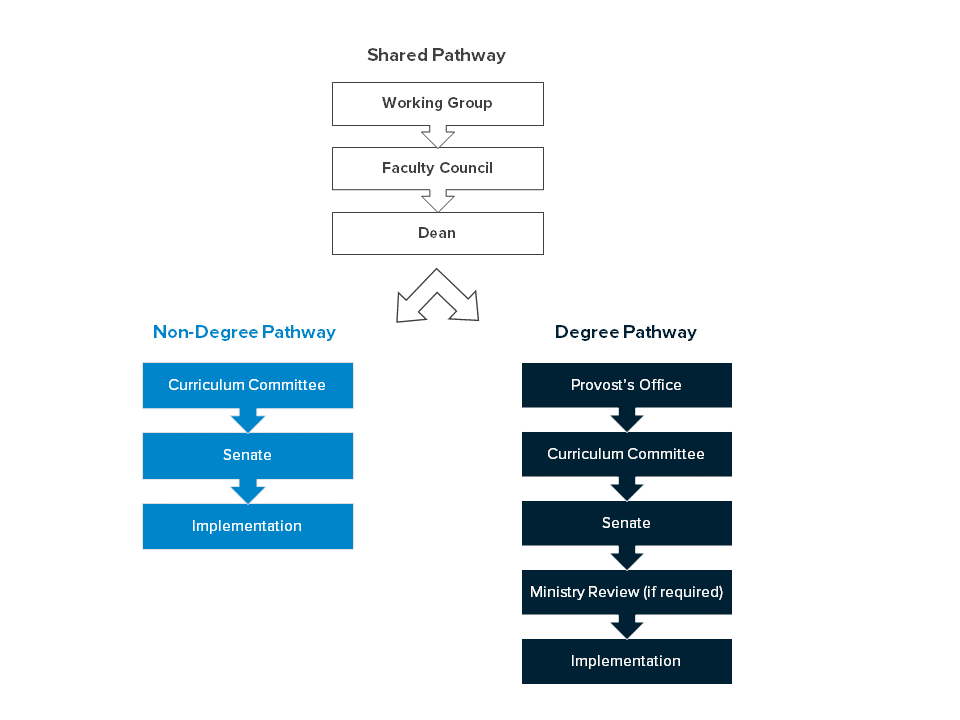
Timelines will vary depending on the scope of the change, approval schedules, budget considerations, and Ministry review requirements.
Non-degree programs
- No increased admission requirements: approximately 6 months.
- Increased admission requirements: approximately 15 months or longer.
Degree programs
- No increased admission requirements and no Ministry review required: approximately 10 to 12 months from proposal development to first intake.
- Increased admission requirements, budget review, and/or Ministry review required: approximately 16 to 24 months from proposal development to first intake.
Working group (advisory)
Proponents are encouraged to assemble a team from relevant areas to provide support during the planning and implementation of program renewals. Depending on the nature of the proposed changes, a working group may include the following individuals and departments:
| Contact/department | When to consult |
|---|---|
| Faculty members | Faculty and peer support
|
| Registration Office | Administrative and student records
|
| Centre for Innovation and Excellence in Learning (CIEL) | Curriculum and learning design
|
| Office of Indigenous Education and Engagement (OIEE) | Indigenous content and perspectives
|
| Educational Advising | Student feedback and impact
|
| Office of University Planning and Analysis (OUPA) | Strategy, data and compliance
|
| Dean, Associate Dean, Financial Assistant, Finance Office, Associate Vice-President, Academic | Resource planning and financial approvals
|
Faculty Council (academic approval)
The Faculty Council reviews the proposal to confirm Faculty support and assess alignment with Faculty strategic priorities and academic quality.
Upon approval:
- Address any feedback and complete the approval section of the Program Change Form and forward the proposal to the Dean
- Upload new courses and course changes with outlines to the Course Management System (CMS). Course outlines are uploaded directly to the CMS; they are excluded from the final proposal package
Best Practice: The Dean's assistant is usually responsible for content changes in CMS
Dean (resources supported)
Submit the proposal to the Dean for feedback and approval. The Dean will:
- assess if changes align with institutional strategic priorities
- assess that the proponent has consulted all relevant stakeholders
- evaluate whether changes can be supported through existing resources or require additional funding, including sourcing any necessary funding for implementation
- recommend the proposal proceed through governance
Upon approval:
- if a degree program change, proceed to Provost review
- if a non-degree program change, proceed to Curriculum Committee
Provost (quality assurance and Ministry determination)
The Office of the Provost and Vice-President, Academic, will:
- track and monitor degree changes that meet the one-third threshold
- determine whether Ministry review is required and confirm Ministry requirements are met
- approve budget requests
- recommend the proposal proceed through governance
Upon approval:
- submit the proposal package to the Curriculum Committee coordinator.
Curriculum Committee (institutional academic review and recommendation)
The Curriculum Committee advises the Senate on key educational standards, including:
- assessing new and updated course requests
- evaluating proposals for new programs or program changes
- program or course admission standards
- consistency across programs and policy compliance
- ensuring alignment with Ministry’s requirements
Submit the proposal to the Curriculum Committee coordinator before the submission deadline. The proponent and the Dean or delegate attend the meeting and provide a brief overview (5 to 10 minutes). Committee members review the proposal package and any associated new courses or changes in the CMS before the meeting and may provide comments.
Upon approval:
- Address feedback and submit a revised proposal to the coordinator if applicable.
Senate (final academic approval)
The Senate has academic approval authority for curriculum revisions. The Curriculum Committee Chair or Vice-Chair presents the proposal to the Senate for educational approval. As members of the Senate, the Deans and Faculty representatives may answer questions. Proponents who are not members of the Senate cannot address questions on the floor of the Senate but may attend as non-speaking guests. Upon approval:
- If a Ministry review is required, proceed to Ministry review.
- If a Ministry review is not required, proceed to implementation.
Ministry (if required)
The Provost’s Office confirms and coordinates the Ministry review process. The Degree Quality Assessment Board (DQAB) will review the proposed change(s) against the new degree criteria and decide whether the changes constitute a new degree. No changes may be implemented until the determination is made and, if deemed a new degree, until the program review is completed and ministerial approval/consent is granted. Upon determination:
- If DQAB deems the proposed change(s) are a new degree, the proponent may be required to develop a new degree proposal.
- If DQAB deems the proposed change(s) are not a new degree, proceed to implementation.
Registration Office (implementation)
The Registration Office will assess whether the requested effective date remains feasible and will adjust it as necessary before implementing changes in the systems.
Calculating curriculum changes
These guidelines help map what constitutes a change to required courses within the ‘Core curriculum tracking’ section of the Program Change Form.
For the purposes of curriculum tracking, courses fall into three categories:
- Required Courses: Individual courses that must be completed to obtain a credential.
- Bundled Required Courses: These are completion requirements within a suite of specific courses where students are provided options and a set number of credits within that suite of options must be completed in order to obtain a credential. This can be a named set of articulated courses or a category of specific courses.
- Elective Courses: These are courses that are required to obtain credits towards the credential, but no specificity or limited specificity is applied to the courses that meet these requirements.
What gets counted?
When reporting the ‘Number of required courses changing’, include only Required Courses and Bundled Required Courses.
Required Courses: Changes to each required course count as one change. This can include:
- a change to the prerequisite(s) for the course (adding or removing)
- adding it to or removing it from the Program Outline
- moving it to a different year in the Program Outline
- changing the course level
- changing the content of the course, which could include the name due to the content change
- adding, changing or removing completion requirements to the course within the Program Outline
If each of these were changes to specific required courses for a typical bachelor's degree program, this would get counted as six changes to required courses (e.g. 6 ÷ 40 × 100 = 15%).
Bundled Required Courses: Changes made to each bundle of required courses count as one change. This can include:
- a change to the prerequisite(s) for any of the specific courses within the bundle (adding or removing)
- adding or removing a bundle of required courses from the Program Outline
- adding to or removing from a bundle of required courses within the Program Outline
- moving a bundle of required courses to a different year in the Program Outline
- changing the course level for any of the specific courses within the bundle
- changing the content for any of the specific courses within the bundle, which could include the name due to the content change
- adding, changing or removing completion requirements for any of the specific courses within the bundle or across a bundle of non-specific courses
If each of these were changes being submitted for a typical bachelor's degree program change, this would get counted as seven changes to required courses (e.g. 7 ÷ 40 × 100 = 17.5%).
What does not get counted?
Changes that do not impact the program outline (matrix) requirements or outcomes of the program or are part of an external accreditation or regulatory body
- Updates to the meaning of the language or appropriate terminology within the course description/content or in the name of the course.
- Articulating changes to required courses mandated by a professional designation, external accreditation or governing body tied directly to the approved program delivery. E.g. CPA or BC’s Ministry of Education and Child Care K-12 Curriculum.
- Changes to general electives or program electives that are not specifically/individually articulated in the program outline.
New program development
Go to the Program Planning website for guidance in developing new credit programs.
Flowchart for the approval process of new non-credit programs
- Statement of Program Completion and/or External Credential Proposal Template (between 24 and 69 hours of instruction)
- Certificate of Program Completion Proposal Template (minimum 70 hours of instruction)
All requests for program changes, new course proposals, and course change proposals can be submitted directly to the Curriculum Committee coordinator.